Holiday Travel Tips for Children with Sensory Needs

Holiday travel can bring excitement and a bit of chaos. For children with sensory needs, unfamiliar environments, loud sounds, and changes in routine can make the experience overwhelming. At SmallTalk Pediatric Therapy, we’ve helped many families prepare for smooth and successful trips by planning ahead, creating structure, and bringing familiar tools from home. Whether you’re heading across town or across the country, these travel tips can help make your journey calmer, happier, and more connected.

1. Prepare Your Child with Visuals and Stories

Children who thrive on routine often benefit from knowing what to expect before a trip. Creating a simple visual schedule or social story can help your child understand each step from packing, driving, flying, arriving, and unpacking. Research shows that using visuals can help reduce anxiety and improve understanding of transitions in children with developmental differences.

Walk your child through what the day might look like, using photos or drawings. You might even watch a short video about airports or road trips together to make the process more predictable and less intimidating.

2. Build a Sensory Travel Kit

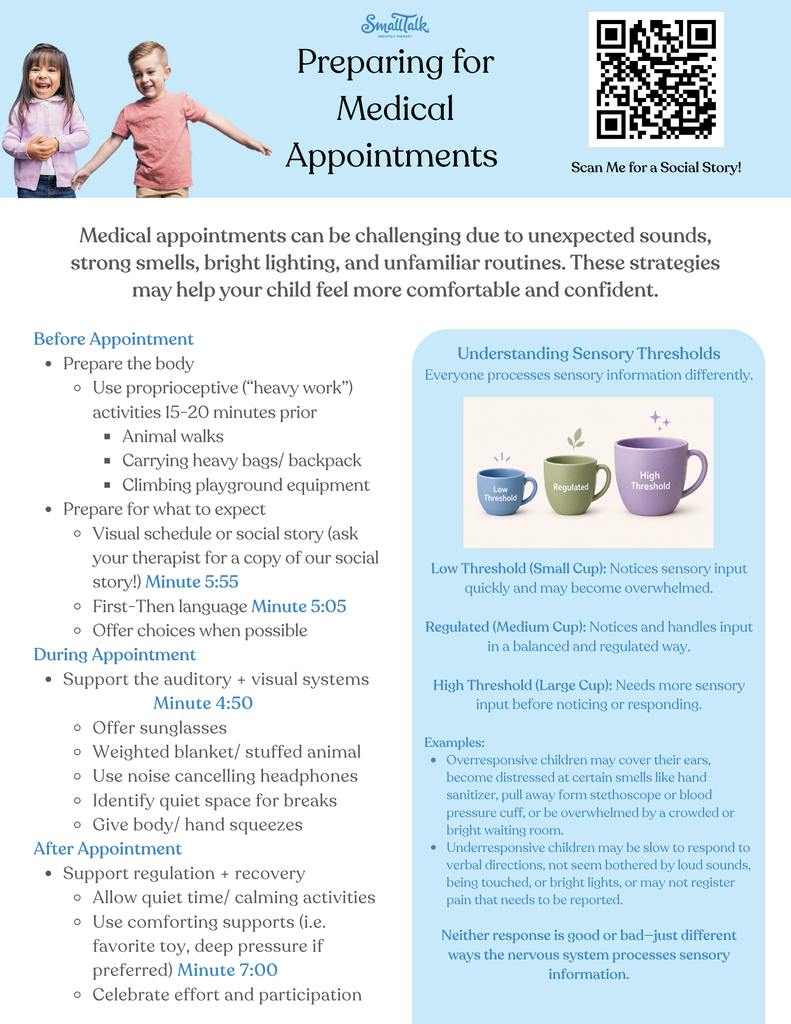
Long trips can expose your child to new smells, sounds, textures, and sights, all of which may be overstimulating. A sensory travel kit gives your child tools to regulate and find comfort along the way.

Try including:

  • Noise-canceling headphones
  • A small weighted lap pad or favorite blanket
  • Sunglasses or a hat to reduce bright lighting
  • Fidget toys or chewy jewelry
  • Familiar snacks and a water bottle

Every child’s sensory system is unique, so let them help choose what to pack. Having control over their environment even a little can make travel feel more manageable.

3. Choose Travel Times and Routes Thoughtfully

Timing can make a big difference. Traveling during quieter hours, such as early mornings or mid-week days, often means fewer crowds and shorter lines. When driving, plan frequent rest stops where your child can stretch, jump, or move before getting back in the car.

It can also help to avoid rushing. Extra time at each step, boarding, restroom breaks, or security, gives everyone breathing room and helps prevent meltdowns from stress or fatigue.

4. Maintain Familiar Routines

Even away from home, maintaining small pieces of your regular routine can help your child feel grounded. Try to keep consistent meal and sleep times, and bring familiar bedtime items like a favorite stuffed animal or book.

Keeping a short bedtime ritual, such as reading a story together, is not just comforting, it also helps your child transition more easily to sleep in new environments. Predictability builds confidence and regulation.

5. Plan for Quiet Spaces and Calm Breaks

During busy holiday events, identify quiet spots in advance where your child can take breaks. Many airports, museums, and large public spaces now offer sensory-friendly rooms or low-stimulation areas.

If you’re visiting relatives, ask ahead if there’s a calm room or corner your child can use when they need downtime. You can also establish a “quiet signal” with your child, a hand gesture or phrase that means, “I need a break.” Giving them a way to communicate their needs can prevent sensory overload before it escalates.

6. Use Travel as a Language and Learning Opportunity

Every part of your journey can help build speech, language, and social skills. Narrate what’s happening: “We’re putting our bags in the car,” or “The airplane is taking off!” Describe what you see, hear, and feel to model rich vocabulary.

Ask open-ended questions:

  • “What do you think we’ll see when we land?”
  • “Can you tell me what’s outside your window?”

These small interactions encourage language use in real-world situations. For children receiving speech or occupational therapy, this kind of meaningful play and communication helps generalize skills beyond the clinic.

7. Be Flexible and Celebrate Small Wins

Even the best-planned trips come with surprises, delays, detours, or changes. Flexibility is key. Offer praise for small victories: getting through a noisy terminal, waiting patiently in line, or using coping tools independently. A calm, encouraging tone helps your child feel secure, even when things don’t go perfectly. Remember that your goal isn’t a flawless trip, it’s connection, confidence, and fun along the way.

Holiday travel with children who have sensory needs doesn’t have to be stressful. With thoughtful preparation, familiar routines, and a bit of flexibility, you can create positive, memorable experiences for your family. At SmallTalk, we support San Diego families, whether at our clinics in La Mesa, Mission Valley, and Scripps Ranch, or through virtual sessions, so your child can keep growing and thriving wherever the season takes you.

Safe travels and happy holidays!

Would you like to start therapy or schedule a virtual appointment during this holiday season?

Contact Form

  • This field is for validation purposes and should be left unchanged.

Preparing for Insurance Changes in the New Year: A Guide for Parents

Parenthood is a rewarding journey filled with joy, milestones, and countless decisions. One of the most important (and often overlooked) responsibilities is understanding your insurance coverage, especially when it comes to services like speech and occupational therapy. With a new year just around the corner, now is the perfect time to review your benefits, make any updates, and ensure your child continues receiving the support they need.

Why It Matters

Insurance coverage can change from year to year, especially if you switch plans during open enrollment. Benefits for services like therapy may vary, and delays in updating or confirming your benefits can interrupt care. That’s why we’re encouraging all families to check their insurance details and notify us of any changes as soon as possible.

Insurance Terms Made Simple

Insurance language can be confusing, so here’s a quick glossary to help:

  • Insurance Policy: A contract outlining coverage, terms, and limits.
  • Coverage: The medical services your plan will pay for.
  • Premium: Monthly amount paid to have insurance.
  • Deductible: What you must pay before insurance starts covering costs. This amount will typically reset in the new year.
  • Coinsurance: The percentage of costs you pay after your deductible is met (e.g. 30%).
  • Copay: A set fee paid at each visit (e.g. $25 per session).
  • Out-of-Pocket Maximum/Catastrophic Cap: The most you’ll pay in a year for covered services (excluding premiums) — after which insurance pays 100%.

Steps to Prepare for the New Year

1. Review Your New Plan

Start by checking if your plan is changing in the new year. If anything about your plan has changed, or you are unsure, please send us a copy of your new insurance card to frontoffice@smalltalkspeech.com.

2. Understand Your Costs

Check what your benefits and patient responsibility are for speech therapy and occupational therapy. This information is typically listed in the “Benefits” section of your plan summary. Ask your insurance provider about:

  • Copayments
  • Deductibles
  • Coinsurance
  • Out-of-pocket maximums

3. Check for In-Network Providers

Is SmallTalk in-network? In-network therapists generally result in lower out-of-pocket costs.

4. Get a Referral if Needed

Some plans require a doctor’s referral before therapy services can begin. Check with your pediatrician and your insurer.

5. Ask About Pre-Authorization

Certain services require pre-approval before coverage begins. Skipping this step could result in denied claims.

6. Know Session Limits & Rules

Plans may place limits on how many sessions your child can attend or may limit coverage based on diagnosis.

7. What to Do if a Claim is Denied

Denied claims can often be appealed. Don’t give up! Ask your insurer for steps to initiate an appeal if needed.

8. Explore School-Based Services

Your child’s school may also offer therapy services, which can be used in conjunction with or as an alternative to private therapy.

9. Keep Communication Open

Share any insurance changes with us right away so we can help avoid coverage gaps and ensure continuity of care. You can contact us at frontoffice@smalltalkspeech.com or 619-647-6157 ext. 7 if you have any insurance updates or have any questions.

How to Check Your Benefits

When you call your insurance company, here are some helpful questions to ask:

  • Is SmallTalk Pediatric Therapy in-network with my plan?
    • You may need our NPI: 1619298791
  • What are my benefits for these CPT codes?
    • Speech Therapy: 92523, 92507
    • Occupational Therapy: 97166, 97168, 97530
  • Is there a deductible that applies, and how much of it has been met?
  • What is my copayment per therapy session?
  • Are there session limits for speech or occupational therapy?
  • Do I need pre-authorization?
  • Are there any diagnosis exclusions?

Always call the Member Services number on the back of your insurance card. If you are having trouble finding it, you can also try the numbers below:

Insurance ProviderMember Services Number
Anthem Blue Cross (CA)1‑800‑967‑3015
Blue Shield of CA1‑800‑443‑5005
Blue Shield Federal (FEP)1‑800‑411‑2583
Kaiser Permanente1‑800‑464‑4000
Sharp Health Plan1‑858‑499‑8300
TRICARE West (TriWest)1‑888‑874‑9378
UnitedHealthcare1‑800‑577‑8539

Final Thoughts

Understanding and preparing for insurance changes doesn’t have to be stressful. Taking the time now to review your benefits, ask the right questions, and share updates with us ensures that your child’s therapy can continue uninterrupted. Please contact us at frontoffice@smalltalkspeech.com or 619-647-6157 ext. 7 if you have any insurance updates or have any questions. We’re here to support you and your family every step of the way.

Let’s work together to make the new year a successful one for your child and their care.

8 Halloween Activities to Boost Your Child’s Development

Halloween is the perfect time to mix festive fun with developmental support for kids. Whether your child is working on communication, sensory processing, or fine motor skills, these activities combine holiday excitement with therapy-friendly strategies you can do at home.

1. Pumpkin Vocabulary Hunt

Explore different pumpkins and talk about size, color, texture, and shape. Words like “big,” “tiny,” “smooth,” or “bumpy” help build descriptive vocabulary.

2. Pumpkin Scooping Sensory Play

Scooping out pumpkin seeds offers a great sensory experience while building hand strength. Encourage squeezing, pulling, and scooping to support fine motor development.

3. Trick-or-Treat Role Play

Practice social phrases like “trick or treat,” “thank you,” and “happy Halloween”. This helps kids prepare for the big night and encourages real-world communication skills.

4. Spider Web Fine Motor Craft

Use yarn or string to weave a spider web across a paper plate or cardboard. Threading supports hand-eye coordination and bilateral hand use.

5. Halloween Storytelling

Start a story with a Halloween prompt like “On Halloween night, I saw…” and let your child finish it. This activity builds sequencing, creativity, and sentence structure.

6. Candy Sorting & Labeling

After trick-or-treating, sort candy by type or color. Encourage your child to describe categories (“chocolate,” “red,” “round”) to strengthen vocabulary and organization.

7. Costume Dress-Up Practice

Encourage your child to put on and take off costume pieces like zippers, buttons, or masks. This builds independence and fine motor dressing skills.

8. Halloween Obstacle Course

Set up a course with crawling under “spider webs” (streamers), balancing on a “witch’s broom” (pool noodle), or jumping over “pumpkins” (pillows). Obstacle play strengthens gross motor coordination and body awareness.

Bringing It All Together

Blending speech, language, and occupational therapy activities into Halloween traditions makes the holiday both fun and beneficial. At SmallTalk Pediatric Therapy, we encourage families to use play as a natural way to support growth and development. Looking for more ideas? Learn more about our speech and language therapy and occupational therapy services.

Inclusive Activities and Resources for Kids in San Diego

At SmallTalk Pediatric Therapy, we believe that progress doesn’t stop at the clinic door. For many families, the most meaningful growth happens when therapy skills carry over into everyday life, whether that’s at the park, in a museum, or through a community program. Luckily, San Diego is full of inclusive activities and resources that align beautifully with speech and occupational therapy goals.

Here are a few local favorites that we often recommend to families:

1. Inclusive Playgrounds and Outdoor Spaces

San Diego has made great strides in creating parks that welcome children of all abilities. Places like Mission Bay, Waterfront Park downtown, and Balboa Park offer wide, accessible play structures and open spaces that encourage movement, social interaction, and imaginative play. From an OT perspective, these playgrounds provide opportunities for climbing, balancing, and building gross motor skills. For speech, they create natural opportunities for children to practice communication in play with peers.

2. Museums with Sensory-Friendly Programs

Several local museums host inclusive events designed with children’s sensory needs in mind. The Fleet Science Center and The New Children’s Museum both offer accessibility programs, and the San Diego Children’s Museum of Discovery provides hands-on learning that is both engaging and adaptable. Visiting these environments can help children generalize skills such as, following directions, asking questions, or practicing turn-taking, in real-world settings.

The New Children’s Museum

3. Inclusive Recreation and Sports Programs

The City of San Diego Parks & Recreation Department’s Therapeutic Recreation Services offers year-round programs for children with developmental needs. Families can also explore adaptive play opportunities like Play My Way and TOPSoccer, both of which emphasize inclusion and fun. These types of organizations are a wonderful complement to therapy, giving children the chance to build confidence and social skills in a supportive environment.

4. Sensory-Friendly Events and Entertainment

Local theaters and organizations host sensory-friendly performances and movie showings, such as AMC’s Sensory Friendly Films and productions at some community theaters. These events are designed so children can move, make noise, or take breaks without worry.

5. Community Support and Learning Opportunities

Organizations like the National Foundation for Autism Research provide resources and host events, while programs like Learning for All offer educational therapy that can complement speech and ot. Local libraries also frequently offer inclusive storytimes that support early literacy and language skills, perfect for families who want to carry speech therapy goals into daily routines.

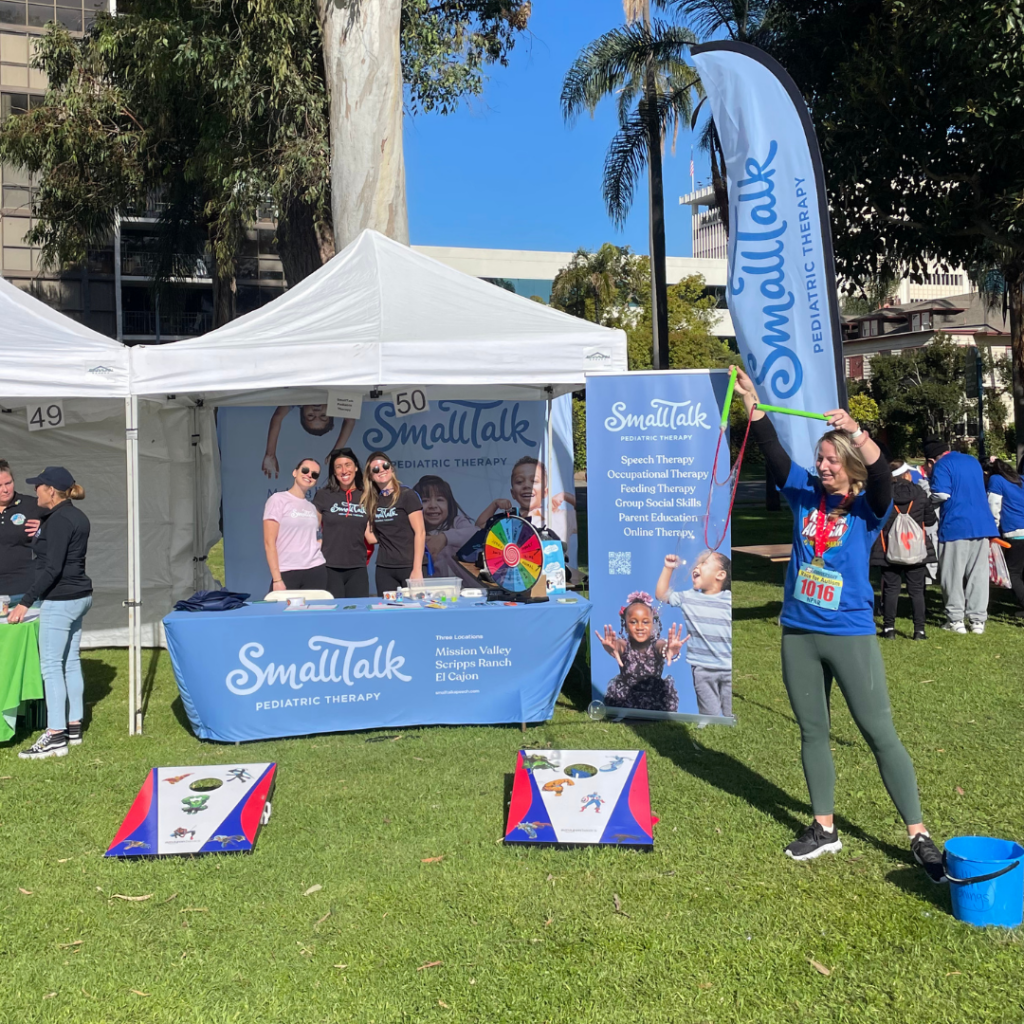
SmallTalk attends the Race for Autism 2025

Why These Resources Matter

At SmallTalk, we see firsthand how important it is for therapy to connect with everyday life. When a child practices communication at storytime, strengthens motor skills on a playground, or builds social confidence on a team, they’re not just learning, they’re living the skills we work on in therapy.

We encourage families to explore these inclusive opportunities around San Diego. They can make a big difference in helping children feel successful, connected, and celebrated both inside and outside the clinic.

Looking for more information about how SmallTalk Pediatric Therapy can help your kiddo grow? Give us a call at 619-647-6157 or email us at hello@smalltalkspeech.com and we can give you more information or schedule an evaluation.

Why Clinic-Based Pediatric Therapy Often Outperforms In-Home Sessions

When your child needs speech-language therapy or occupational therapy, choosing the right setting can make a significant difference in their progress. While in-home therapy can feel convenient, many families are surprised to learn that clinic-based therapy often offers more advantages, both for the child’s development and for the family’s overall experience.

If you’re considering where your child should receive services, here’s why a clinic-based model may be the stronger option for long-term success.

1. Fewer Distractions, More Focus

Home environments are full of everyday distractions such as pets, siblings, television, and toys that aren’t part of therapy. These can make it harder for a child to fully focus on their goals. In a clinic setting, the space is purposefully designed for learning and engagement. Everything from the layout to the materials is tailored to help children stay on task and maximize each therapy minute. At SmallTalk, our toys and activities are chosen with your child’s development in mind. Every single activity has a bigger purpose.

2. Access to Specialized Equipment and Materials

Clinics are equipped with therapeutic tools and activities that most homes simply can’t replicate, think sensory gyms, fine-motor skill stations, and advanced speech-language resources. These specialized materials give therapists more ways to engage your child, challenge their skills, and accelerate progress. Where else can your child build their own obstacle course with multiple swings, ropes, a climbing wall, and more?

3. Opportunities for Peer Interaction

In a clinic, your child can see other children working hard toward their own goals. Even without direct group sessions, watching peers model language, social skills, and cooperation can inspire confidence and motivation.
Peer interaction is especially important for building real-world communication and social skills, something that’s harder to simulate in a one-on-one home setting.

4. Clear Separation Between “Home” and “Work”

When therapy happens at home, it can be hard for children to mentally shift between playtime and “therapy time.” In a clinic setting, walking through the door signals that it’s time to learn, work, and grow. Clinic-based sessions typically operate on a regular schedule, with fewer interruptions from outside factors. This consistency is vital for building momentum in therapy and helping children reach their goals faster.
This separation also helps parents establish a healthy boundary, home remains a safe, relaxed space, while the clinic is where focused skill-building happens.

5. Access to a Collaborative Team

In a clinic, your child’s therapist can collaborate in real time with other speech-language pathologists, occupational therapists, and support staff. This teamwork means your child benefits from multiple professional perspectives, shared resources, and coordinated care, something that’s much harder to achieve in a home-based model.

6. Increased Parent Support and Education

Clinic visits create natural opportunities for parents to observe their child, connect with therapists, ask questions, and receive hands-on coaching. You will gain access to other in-clinic resources that simply aren’t part of most in-home programs.

Why This Matters for Your Child’s Development

Early intervention matters, but so does the quality and structure of the therapy your child receives. A clinic-based setting creates an environment that’s more engaging, better equipped, and more socially enriching, setting your child up for long-term success.

At SmallTalk Pediatric Therapy, we’ve seen firsthand the difference that the right setting can make. Our clinics are designed to be fun, welcoming, and filled with the tools your child needs to thrive. We work closely with families to ensure that every session moves your child closer to their goals, whether that’s clearer speech, improved fine motor skills, or greater confidence in daily activities.

If you’re considering a change in your child’s therapy setting, we’d be happy to answer your questions and show you what’s possible in a clinic-based model.

Give us a call at 619-647-6157 or send us an email at hello@smalltalkspeech.com if you’d like to get started.

Identifying Speech and Language Delays: A Guide for Referring Providers

As a pediatrician or primary care provider, you are often the first professional a family consults when they have concerns about their child’s development. One of the most common questions parents ask is:

“Is my child’s speech development on track, or should I be concerned?”

Speech and language delays are among the most prevalent developmental concerns in early childhood, yet many children with delays are not identified or referred for support until after critical early windows have passed. Early intervention and timely referrals can significantly improve long-term outcomes in communication, academic readiness, and social-emotional health.

This guide outlines key speech and language early indicators, supported by current research, to help guide your decisions around when to refer for a speech-language evaluation.

The Prevalence of Speech and Language Delays

According to the National Institute on Deafness and Other Communication Disorders, approximately 8-9% of young children have a speech sound disorder, and 7-8% of preschool children have language delays that may affect learning, behavior, and social interaction.

While every child develops at their own pace, persistent delays or lack of progress in key communication areas can indicate the need for further evaluation. Below are typical early indicators that suggest a child may benefit from a referral to a speech-language pathologist.

Early Indicators of Speech and Language Delays

By 12 Months

  • Does not babble with a variety of sounds (e.g., “ba,” “da,” “ga”)
  • Does not respond to name or familiar voices
  • Limited use of gestures (e.g., pointing, waving)

By 18 Months

  • Says fewer than 10 meaningful words
  • Does not attempt to imitate words or sounds
  • Cannot follow simple one-step commands without gestures

By 24 Months

  • Says fewer than 50 words
  • Not combining two words (e.g., “more juice,” “mama help”)
  • Speech is largely unintelligible to caregivers

By 36 Months

  • Struggles to form simple sentences
  • Speech is unclear to unfamiliar listeners more than 50% of the time
  • Limited vocabulary for age
  • Difficulty answering basic “wh” questions (e.g., what, where)

At Any Age

  • Regression in language skills
  • Persistent drooling or oral motor difficulties
  • Frustration or behavior issues related to difficulty communicating

Why An Early Referral Matters

Research supports early intervention as a key predictor of long-term success in children with language delays.

  • Children who receive therapy before age 3 make significantly greater gains in expressive language skills than those who begin later.
  • Without support, early speech and language delays can evolve into academic struggles, including reading and writing difficulties.

The earlier children receive therapy, the more effective and efficient their progress tends to be, both developmentally and from a resource perspective.

Our Approach at SmallTalk Pediatric Therapy

At SmallTalk, we specialize in evaluating and treating children with speech and language delays from infancy through school age. We understand that your time with families is limited, and our role is to support both you and your patients by providing:

  • Prompt evaluations and clear feedback
  • Family education and involvement in treatment planning
  • Collaborative care with pediatricians, early childhood educators, and specialists
  • Evidence-based, play-centered therapy that fosters engagement and growth

Whether a child is showing subtle signs of delay or more significant concerns, our team is here to help determine whether intervention is needed, and to guide families with care, compassion, and clinical expertise.

How to Refer

Referrals can be sent directly via fax or by calling our administrative team. We welcome direct conversations with providers who may want to discuss a particular case or family dynamic prior to referral.

If you’re unsure whether a child qualifies, we’re happy to offer an evaluation and determine if therapy is appropriate.

You as the primary care provider are the starting point for families. By identifying and referring children early, you play a critical role in shaping their communication journey—and in many cases, changing their trajectory for life.

SmallTalk Pediatric Therapy Is Now Accepting Sharp Community Medical Group Insurance Plans!

We are excited to announce that we are now in-network with Sharp Community Medical Group (SCMG) HMO insurance plans, including those assigned through:

  • Palomar Health Medical Group HMO
  • And Graybill Medical Group HMO

If your child’s insurance card shows SCMG, they are eligible to receive covered therapy services at any of our clinic locations. 

This expansion means we can now support even more families across San Diego County with:

How to Get Started

If your child’s insurance card says “Plan Medical Group: SCMG”, you may now be eligible for in-network services. We’re happy to verify benefits, walk you through the referral and intake process. 

We know how important it is to find trusted, accessible care, and we’re honored to support your child’s growth, communication, and confidence every step of the way.

Contact us to schedule an evaluation

619-647-6157 

frontoffice@smalltalkspeech.com

Should My Child Start Speech Therapy? What Parents Should Know

When you’re worried about your child’s speech development, it can feel overwhelming to know what to do next. Maybe you’ve heard well-meaning advice like, “They’ll grow out of it,” or “Just wait and see.” But how do you know if waiting is the right choice? What if early speech therapy could help your child thrive?

At SmallTalk Pediatric Therapy, we often meet parents who aren’t sure whether to seek support or give their child more time. Here’s what you should know to make an informed decision.

Understanding Speech and Language Milestones

All children develop at their own pace, but there are general milestones most kids reach around certain ages. For example:

  • By 12 months: Babbling, using gestures, responding to their name.
  • By 18 months: Saying about 10–20 words.
  • By 2 years: Using two-word phrases (“more juice,” “mama help”).
  • By 3 years: Speech is clear enough for familiar adults to understand most of what they say.

You can read more about specific milestones with our Developmental Checklist. If your child is significantly behind in these milestones, it may be time to consider an evaluation.

The “Wait and See” Approach

Many parents are told to wait and see if their child will “catch up.” While this can be appropriate in some cases, especially when there is steady progress, delaying help can also mean missing the window when therapy is most effective.

Should My Child Start Speech Therapy? What Parents Should Know

Research shows that early intervention leads to better outcomes in speech and language development. If a delay is identified early, therapy can help build skills before gaps widen.

A 2011 meta-analysis published in the American Journal of Speech-Language Pathology found that parent-led early speech interventions significantly improved expressive language in young children—especially those under age 3 (Roberts & Kaiser, 2011). These findings support the importance of not delaying care when communication concerns arise.

Benefits of Starting Speech Therapy Early

Here are a few reasons why acting early can be so powerful:

  • Brain Plasticity: Young children’s brains are more adaptable, making it easier to learn new communication skills.
  • Confidence: Kids often feel frustrated when they can’t express themselves. Therapy helps reduce this frustration and build self-esteem.
  • Social Connection: Communication delays can impact play and peer relationships. Early support helps kids engage more successfully with others.
  • Family Support: Therapy gives you tools and strategies to help your child at home.

When to Seek an Evaluation

You don’t need a referral to have your child evaluated by one of our speech-language pathologists. If you notice any of the following, it’s a good idea to schedule an eval:

  • Your child is not meeting speech milestones for their age.
  • They appear frustrated by not being understood.
  • They rarely imitate sounds or words.
  • You have a gut feeling that something isn’t quite right. Trust your instincts—you know your child best.
When to Seek an Evaluation

How SmallTalk Pediatric Therapy Can Help

At SmallTalk, we believe in early, compassionate, play-based therapy that meets kids where they are. Our licensed speech-language pathologists will:

  • Assess your child’s speech and language skills.
  • Create an individualized treatment plan.
  • Guide you on how to support your child at home.
  • Celebrate every success, big and small!

You Don’t Have to Wait and Wonder

If you have concerns about your child’s speech, you don’t have to navigate them alone. Early intervention doesn’t mean something is “wrong”, it means you’re giving your child every opportunity to communicate confidently.

Contact us today to schedule a speech evaluation. We’re here to help.

New Chapter, Same Heart

In 2004, my third child was born eight weeks early. Like many of the families we now serve, I found myself suddenly navigating a world I hadn’t planned for—one filled with delayed milestones, specialists, and therapy appointments. He didn’t walk independently until nearly two years old. At the time, we lived in La Mesa, and I was driving over 30 minutes each way for physical therapy appointments twice a week. It was exhausting—managing traffic, parking, wrangling my two other little ones in the waiting room, and trying to make it all work.

I was a speech-language pathologist myself and had always believed in the power of family-centered care. But what we were experiencing didn’t feel that way at all. It felt like we were just going through the motions, not being seen as a whole family with unique needs. And that’s when the idea for SmallTalk started to take shape. I knew East County needed something different—something warmer, more supportive, more centered on both the child and the family.

We opened SmallTalk in a 300-square-foot office on Chase Avenue in El Cajon. That tiny space was full of heart and big dreams. Over the years, we expanded within the same building, eventually growing into the clinic many of you have come to know and love. In 2011, we opened a second location in Sabre Springs, followed by Old Town in 2014—both of which eventually found new homes in Scripps Ranch and Mission Valley.

Through all this growth, East County remained our home base. It’s where we started. It’s where we stayed.

Now, after more than 20 years in the same El Cajon building, we’re taking the next step: just four miles down the road to La Mesa. Starting June 23rd, our East County clinic has a brand-new home at:

7862 El Cajon Blvd., Suite 200, La Mesa, CA 91942

New Chapter, Same Heart

This new clinic was designed with families in mind—more therapy rooms, a bigger gym, a cozy waiting area, and (a personal favorite) much easier parking. And most importantly, it’s the same caring team, the same playful, child-led therapy, and the same commitment to your family.

Watching SmallTalk grow from that tiny office to over 17,000 square feet across San Diego has been one of the greatest joys of my life. We’ve added Child Development Centers, virtual services, and more—but what hasn’t changed is our heart. East County isn’t just where we started—it’s who we are.

To all the families who have trusted us over the years: thank you. You’ve helped shape SmallTalk into the place it is today. We can’t wait to welcome you into our new La Mesa space and continue this journey together.

With gratitude,
Jen Traina
CEO and Founder, SmallTalk Pediatric Therapy

Summer Speech & OT Tips: Five Ways to Support Your Child’s Development at Home

Summer break is here—and while it’s a great time to relax and recharge, it can also be the perfect season to support your child’s developmental goals through fun, play-based activities. Whether your child is working on communication, motor skills, or sensory regulation, there are plenty of simple ways to keep therapy going at home.

At SmallTalk Pediatric Therapy, we believe that kids learn best through play—and summer is full of playful opportunities. Here are some therapist-approved tips to help you make the most of the season.

1. Build Speech Skills Through Everyday Moments

Language is everywhere! Use summer outings—like beach trips, park days, or even grocery runs—to model vocabulary, ask open-ended questions, and encourage your child to describe what they see or feel. For younger children, narrate your activities and encourage imitation. For older kids, play games like “I Spy” or storytelling prompts in the car.

Summer Speech & OT Tips: Five Ways to Support Your Child’s Development at Home

Try this: Pack a “summer bag” and talk through each item: “This is sunscreen. It keeps our skin safe!”

2. Make Sensory Play a Daily Routine

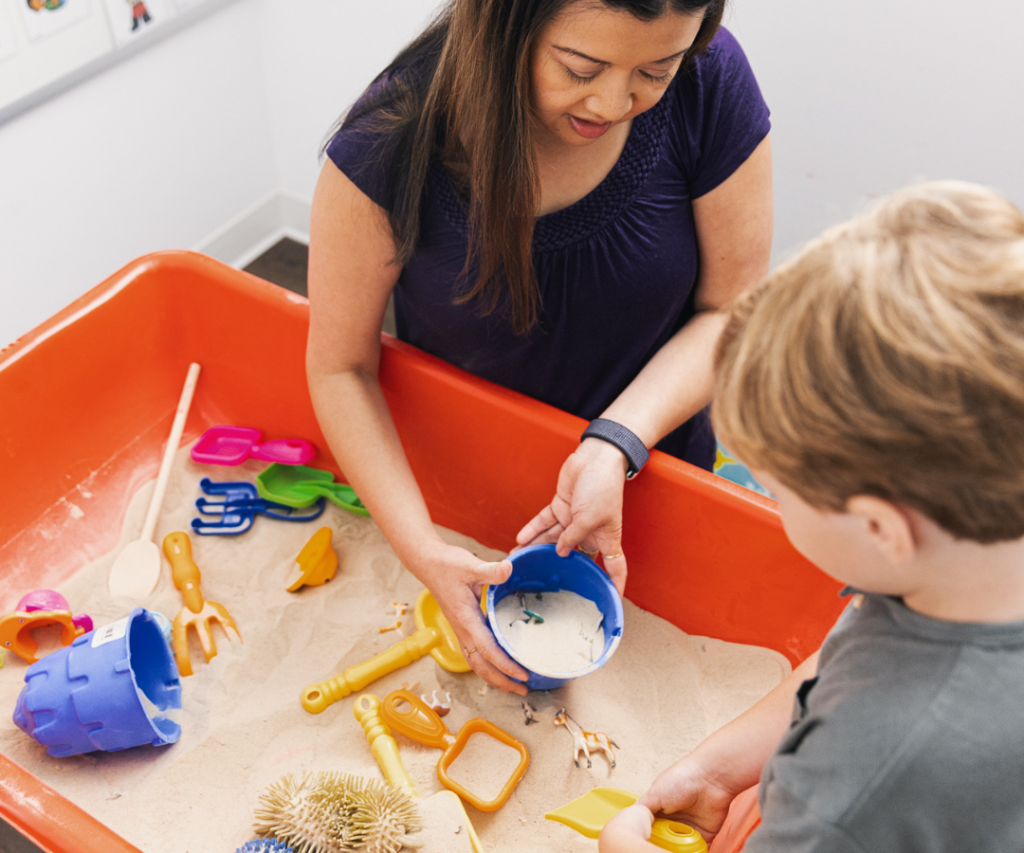
Sensory bins, sand play, water tables, and even messy play with shaving cream or finger paint can help children with sensory processing challenges stay regulated and engaged. Summer is a great time to get messy outdoors!

Try this: Fill a bin with water, sponges, and cups for a simple, calming sensory station.

3. Strengthen Fine Motor Skills with Summer Crafts

From sidewalk chalk to water balloons, summer is full of hands-on activities that boost coordination. Crafts like beading, finger painting, and cutting shapes are great for improving grip strength and control—key goals in occupational therapy.

Strengthen Fine Motor Skills with Summer Crafts

Try this: Make homemade lemonade and let your child squeeze the lemons, stir, and pour—great for hand strength and sequencing.

4. Keep a Routine—but Keep it Flexible

Kids thrive on predictability. Try keeping some structure to your summer days (e.g., morning chores, mid-morning activity, afternoon free play), but allow room for spontaneity. Consistent mealtimes, bedtime routines, and regular movement breaks support both sensory and communication development.

Tip: Use visual schedules to help your child understand what’s coming next.

5. Stay Connected with Your Therapy Team

If your child is enrolled in speech or OT over the summer, be sure to attend regularly—and talk with your therapist about summer goals and carryover activities. If you’re taking a break, ask for a few at-home strategies to keep skills fresh.

Not in therapy yet? Summer is a great time to schedule an evaluation or get started without the school-year rush!

SmallTalk is Here to Help All Summer Long

At SmallTalk Pediatric Therapy, we’re here to support your family year-round—with fun, effective, and compassionate care. Whether you’re continuing therapy this summer or want ideas to use at home, our team is always happy to share tools and encouragement.

If you have questions about your child’s speech, motor, or sensory development, schedule an evaluation today.

Here’s to a summer full of growth, play, and connection!

Link copied to clipboard!