What Is Applied Behavior Analysis (ABA)? Discover ABA the SmallTalk Way

What Is ABA, Really?

Applied Behavior Analysis (ABA) is the science of how behavior works, applied to help children build skills that matter such as communicating a need or want, playing with a sibling or friend, tolerating a haircut, following a group instruction at school or during soccer practice, while reducing behaviors that get in the way of a child’s safety, learning, or connection. It’s not about reducing behaviors that are simply atypical.

At its core, ABA is the science of how people learn: why we do the things we do, and why we don’t. It breaks learning down into its smallest parts, which lets us understand exactly how an individual child is learning right now, and then teach them how to learn more effectively from the world around them.

Typically developing children are learning constantly, from the moment they wake up until the moment they go to bed, almost entirely by absorbing what’s happening around them. It’s why a child will pretend to put makeup on after watching their parent in the mirror, or why they pretend to make dinner after watching a parent make a meal, without being explicitly taught. 

Children with autism or other developmental disabilities often learn differently from that incidental, absorb-it-without-trying process, picking up fewer skills that way, not because something’s missing, but because their brains are wired to take in and process the world differently. ABA doesn’t try to override that; it helps build the skill of learning from the environment in a way that works with how this particular child’s brain already takes information in, by deliberately creating the same kinds of learning opportunities that would otherwise happen by accident.

In practice, that looks like:

  • A Board Certified Behavior Analyst (BCBA) assessing a child’s current skills and the specific behaviors a family wants to build or reduce.
  • A written plan with measurable goals, not vague aspirations, but targets that can be tracked session over session.
  • Reinforcement, access to something meaningful to the child, used to build new skills, not punishment used to suppress old ones.
  • Ongoing data collection so the plan changes when the data says it should, rather than staying on autopilot.

Done well, ABA doesn’t look clinical or rigid; it looks like play. A child should be learning, laughing, and having fun for the entire session, because engagement is what makes new skills stick. Sessions are also meant to be intensive but relatively short-term: the goal isn’t years of dependence on therapy, it’s building skills quickly enough that a child gains the tools to keep learning on their own, long after sessions end.

Modern ABA has evolved significantly from its early, outdated practices. Today, quality care is defined by two core commitments: it is assent-based and neuroaffirming.

What “assent-based” actually means

Assent-based care means therapy is done with a child, not to them. Consent is continuous and moment-to-moment rather than a one-time formality. If a child turns away or shows distress, we honor that as vital communication, not a behavior to extinguish. We explicitly teach children to protest or ask for a break, ensuring every request is respected. True assent-based care measures success by the child’s partnership and engagement, never by compliance.

What “neuroaffirming” actually means

Neuroaffirming care recognizes autism as a natural human difference, not a deficit to fix. Our goals prioritize a child’s wellbeing and independence over social conformity. We honor self-regulation behaviors like sensory-seeking behaviors and value all forms of communication, whether spoken, AAC, or gestures, as inherently valid and meaningful.

What Is ABA the Smalltalk Way?

Most ABA companies are built around one discipline. A BCBA writes a behavior plan, a team of technicians implements it, and if your child also needs speech or occupational therapy, you’re the one coordinating between three separate providers, three schedules, and three offices that may never speak to each other.

Smalltalk is built differently, and the difference isn’t a slogan: it shows up in three concrete places.

1. One plan, not three

At an ABA-only provider, your BCBA writes a behavior plan without input from a speech-language pathologist or occupational therapist, because there isn’t one on staff. At Smalltalk, the plan is built with input from ABA, speech, and OT before it’s finalized, so a communication goal and a behavior goal are never working against each other.

2. Staff who talk to each other on a schedule, not by accident

Ask an ABA-only provider how often your child’s therapist talks to your child’s outside speech or OT provider. Often the honest answer is “when a parent forwards an email.” At Smalltalk, the team meets on a recurring cadence about your child specifically, and that’s staffed as part of the job, not squeezed in.

3. One point of contact

When care is fragmented across providers, parents become the default project manager — relaying updates, resolving conflicting advice, deciding whose recommendation to follow when they disagree. Coordinated care means your family has one point of contact who can speak to the whole picture, not just their slice of it.

Learn More

Think ABA at SmallTalk might be right for your child? Fill out our interest list below and we will be in contact with you soon:

How Occupational Therapy Supports Children with Autism: Building Skills for Everyday Life

As we recognize Autism Acceptance Month and Occupational Therapy Month in April, it’s a meaningful time to celebrate each child’s unique strengths and the ways thoughtful support can help them grow. In fact, it’s the perfect opportunity to highlight how occupational therapy can play a meaningful role in helping children with autism thrive in their everyday lives.

Every child experiences the world differently. For children with autism, those differences can show up in how they communicate, play, process sensory input, and navigate daily routines. Occupational therapy helps bridge those gaps by building skills in a way that feels natural, supportive, and individualized to each child.

What Is Occupational Therapy?

Occupational therapy focuses on helping children develop the skills they need for everyday life. For kids, that includes things like playing and interacting with others, managing daily routines like dressing and feeding, regulating emotions and attention, and participating in school and community activities

At its core, OT meets children where they are and helps them build the skills needed to participate more fully in their world.

How Can Occupational Therapy Support Children with Autism Spectrum Disorder?

Children on the autism spectrum often benefit from occupational therapy in several key areas:

1. Sensory Processing and Regulation

Many children with autism experience the world in a more intense or different way. Sounds may feel louder, textures may feel uncomfortable, or movement may be either overwhelming or highly sought after.

OT helps children:

  • Better tolerate different sensory experiences
  • Develop coping strategies for overwhelming environments
  • Build regulation skills for calmer, more focused participation

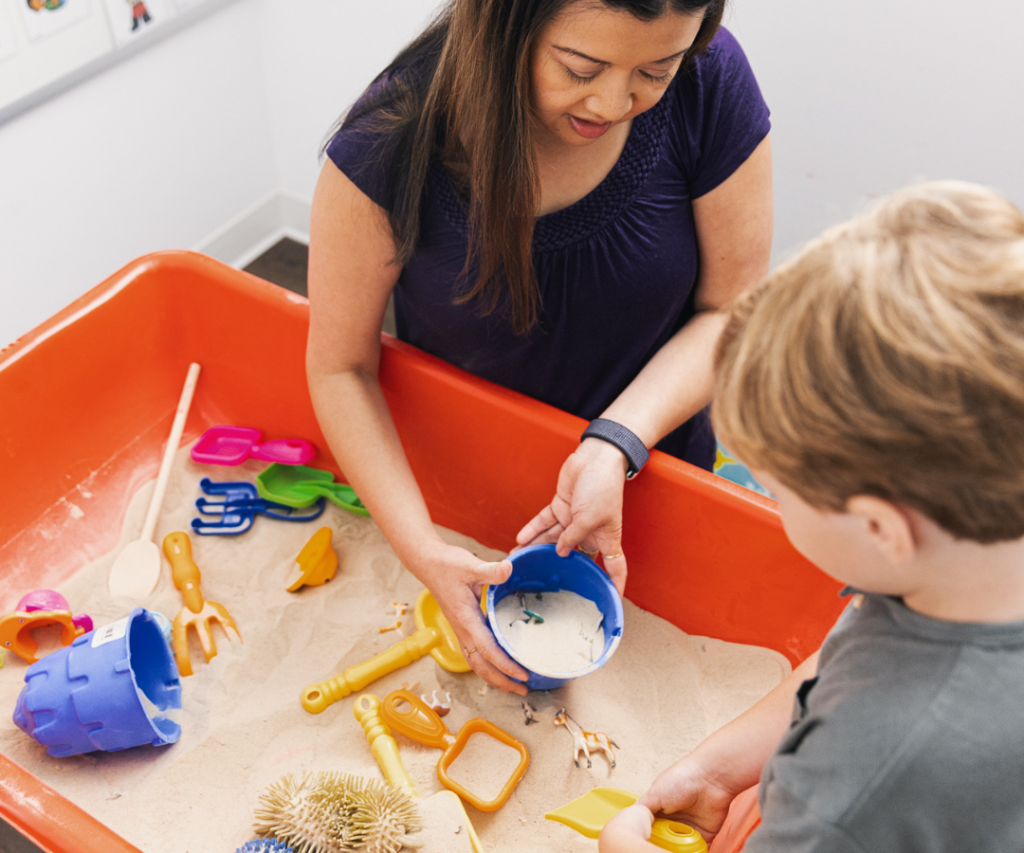
This might look like creating a sensory-friendly routine, introducing calming strategies, or helping a child feel more comfortable with everyday experiences like haircuts or mealtimes.

2. Emotional Regulation and Transitions

Big emotions can be difficult for any child, but for children with autism, transitions and unexpected changes can feel especially challenging.

OT supports:

  • Flexible thinking
  • Transitioning between activities
  • Managing frustration and anxiety
  • Developing calming strategies that work for the child

Over time, these skills help children feel more confident and secure in their day-to-day routines.

3. Play and Social Participation

Play is how children learn. It’s also how they build communication, problem-solving, and social skills.

Occupational therapy helps children:

  • Engage in back-and-forth play
  • Explore imaginative and pretend play
  • Build joint attention and shared experiences
  • Increase comfort interacting with peers

These foundational skills often overlap with speech and language development, making collaboration between OT and speech therapy especially valuable.

4. Daily Living Skills

Independence looks different for every child, and OT supports progress in meaningful, functional ways.

This may include:

  • Dressing and grooming
  • Feeding and utensil use
  • Following routines
  • Participating in school tasks

The goal isn’t perfection. It’s helping children feel capable and confident in their everyday lives.

A Strengths-Based, Family-Centered Approach

At SmallTalk, we believe that therapy should support the whole child and their family. That means building on each child’s unique strengths while respecting their individual differences, and supporting parents with practical, real-life strategies that carry over beyond the therapy room.

Our goal is to create a positive, engaging experience where children feel comfortable, capable, and understood. Occupational therapy isn’t about changing who a child is. It’s about giving them the tools to navigate their world in a way that feels successful and empowering.

When to Consider Occupational Therapy

You might consider an OT evaluation if your child:

  • Has strong reactions to sounds, textures, or movement
  • Struggles with transitions or daily routines
  • Has difficulty with play or interacting with peers
  • Experiences frequent meltdowns or regulation challenges
  • Shows delays in self-help skills like feeding or dressing

Early support can make a meaningful difference in helping children build skills and confidence over time. At SmallTalk Pediatric Therapy, our occupational therapists work closely with families to create individualized, supportive plans that fit into real life, not just the therapy room.

If you’re wondering whether occupational therapy could support your child, we’re always here to talk it through. Give us a call at 619-647-6157 or email us at hello@smalltalkspeech.com

Community and Support

If you’re looking for ways to get involved or connect with other families in the San Diego community, local events like the Race for Autism hosted by the National Foundation for Autism Research (NFAR) are a wonderful place to start. Each year, this event brings together families and organizations in a supportive, family-friendly environment focused on connection and awareness. 

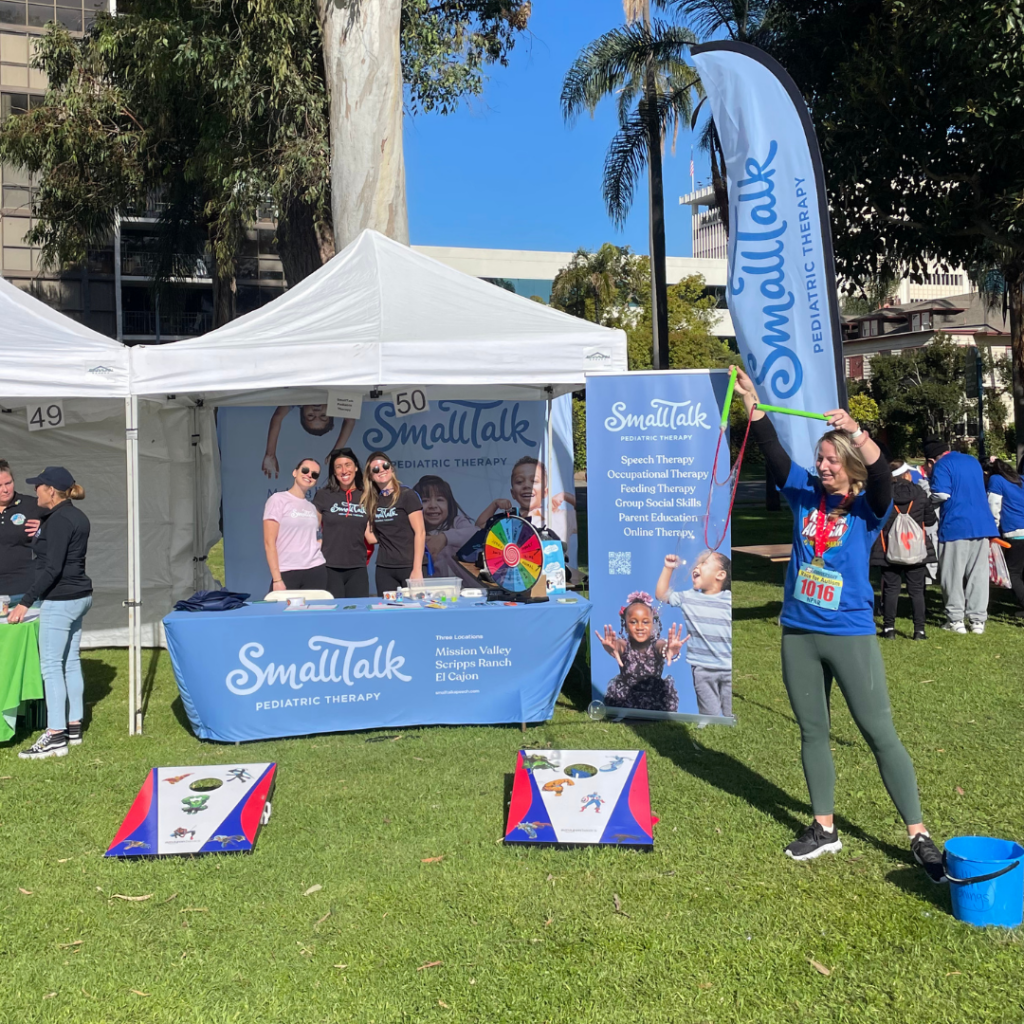
SmallTalk Pediatric Therapy participates each year and hosts a booth, and we always love the opportunity to meet families, answer questions, and connect outside of the clinic. Whether you’re new to the journey or have been part of the community for years, it’s a meaningful way to feel supported and connected.

Autism Acceptance Month is a time to build understanding and celebrate differences. Occupational Therapy Month is a time to recognize the impact of meaningful, skill-building support. Together, they highlight something important: With the right support, every child can grow, connect, and thrive.

My child was just diagnosed with autism spectrum disorder… Now what?

Step 1: Take a deep breath!

Learning that your child has been diagnosed with Autism Spectrum Disorder, or ASD,
can understandably flood parents and caregivers with a range of overwhelming emotions.
It’s easy to feel trapped or condemned by a label. When the “what ifs” start to invade,
remember that this new information does not change who your child is or who you
already know them to be. It is simply an identification of a root cause for various
symptoms and the first step to helping your child reach their full potential.

Step 2: Free your child (and yourself) from expectations

Following a diagnosis of ASD, it is common for parents and caregivers to experience a
period of mourning for “normality” and feelings of uneasiness when thinking about the
future. However, the new diagnosis is not a predictor of the future, let alone a sentence to
a life of failure or unhappiness. Taking one day at a time and celebrating any progress,
no matter how small, is key in cultivating both acceptance and a sense of hope.

Step 3: Advocate for your child

With a new diagnosis comes a plethora of recommendations from medical and school
professionals. Always remember, though these recommendations are backed by research
and have been proven to help, you have the final say in your child’s treatment. Though
30 hours of therapy per week might be recommended, you may feel that is too much. Go
with your instinct! Your child’s team of professionals will work with you to ensure the
best possible treatment to match your child’s individual needs.

Step 4: Find community

No one has to face the journey alone! Consider joining a virtual or in-person support
group for parents and caregivers of children with Autism, or an online forum. Sometimes
well-meaning family and friends can misunderstand and unintentionally cause more pain,
so it can be important to connect with people who do understand. Autism Society San Diego offers both support groups for parents/caregivers and fun events for the entire family. Military families can take advantage of the Exceptional Family Member Program
(EFMP) for a range of family support. When in doubt, meetup.com is a great place to
start!

Step 5: Take care of yourself!

Self-care is often placed on the backburner when caring for a child who has an ASD
diagnosis. However, burn-out is not only emotionally draining for you, but is also
unhelpful for your child. It’s important to seek Respite Care services if you don’t have a
friend or family member to babysit while you take time for yourself to recharge. In
addition, pick your battles with your child. Rome wasn’t built in a day, so anticipating
immediate results and/or perfection can contribute to high stress levels.

Checklist, in no particular order:

  • Developmental evaluation (medical) through your doctor or San Diego Regional Center. It is important to get a medical diagnosis, not just an educational label
    through the school district. This is not the same as a formal diagnosis.
  • Speech therapy (medical/outpatient)
  • Occupational therapy (medical/outpatient)
  • Behavioral therapy (e.g., ABA) (in home or in facility)
  • Apply for school services at age 2 and 10 months to begin at age 3. This will determine eligibility for services through the school district such as, speech
    therapy, occupational therapy, and behavioral therapy. Your child can receive these therapies in both the medical and school setting, as medical and educational
    services are autonomous from one another.

Written by: Kat Winger, MS CCC-SLP

Link copied to clipboard!