Free printable guides, sensory strategies, and social stories to help children prepare for community experiences.
Created by: Mackenzie Garcia, Occupational Therapy Student. Completed in partial fulfillment of the requirements for the degree of Doctor of Occupational Therapy.
Reviewed by: Rachael Todaro, OTD, OTR/L
Is your child nervous about their next haircut? Worried about a trip to the dentist? Overwhelmed by public restrooms or medical appointments?
New experiences can be challenging for children, especially when they involve unfamiliar routines, sounds, smells, movement, touch, or other sensory input. Preparing children ahead of time and helping them understand what to expect can make these experiences feel more predictable and manageable.
Below are free resources to give parents practical strategies they can use before, during, and after some of the everyday experiences that may be challenging for children. Each topic includes a parent guide with helpful tips as well as a child-friendly social story that can be read together before the experience.
Whether you’re preparing for your child’s first haircut, an upcoming doctor’s appointment, or simply looking for ways to make everyday experiences a little easier, we hope these free resources are helpful for your family.
Free Resources for Parents & Kids
Below you’ll find a free comprehensive video, parent handouts, and social stories for several community experiences that are frequently challenging for children with sensory processing differences. We recommend watching the video, reviewing the parent handout, and then sharing the social story with your child before the experience.
Watch: Supporting Children With Sensory Processing Challenges in the Community
In this video, learn more about sensory processing and strategies that can help children feel more comfortable and confident during everyday experiences in the community.
Preparing for a Haircut
Haircuts can be challenging for some children because of unfamiliar sensations, sounds, and routines. Hair clippings touching the skin, water being sprayed on the hair, scissors or clippers, and having someone touch the child’s head can all be new or uncomfortable experiences.
There are several ways parents can help prepare their child before the appointment, including practicing pretend haircuts at home, looking at pictures or videos of a salon or barbershop, and using a visual schedule or social story. During the appointment, children may benefit from a preferred toy or comfort item, breaks as needed, and simple, predictable explanations of what will happen next.
Afterward, give your child time to regulate and recover if needed. Quiet time, a calming activity, a favorite toy, or another familiar comfort can help. Most importantly, celebrate your child’s effort and participation.
Free Haircut Resources
The social story walks children through what happens at a salon or barbershop, including sitting in the chair, wearing a cape, getting their hair wet, hearing scissors or clippers, and what they can do if they feel worried.
For Parents:

For Kids:

Preparing for Hair Braiding
Hair braiding can involve prolonged touch to the scalp, pulling or tension on the hair, sitting still for an extended period, and unfamiliar sounds or sensations. Preparing your child ahead of time can help make the experience more predictable and comfortable.
Free Hair Braiding Resource
For Kids:

Preparing for a Dentist Visit
A trip to the dentist can involve many unfamiliar sights, sounds, smells, sensations, and routines. Preparing your child ahead of time can help make the experience feel more predictable.
A social story can introduce what your child may see and experience before the appointment, while sensory strategies can help your child feel more comfortable during the visit.
Free Dentist Visit Resources
For Parents:

For Kids:

Preparing for a Medical Appointment
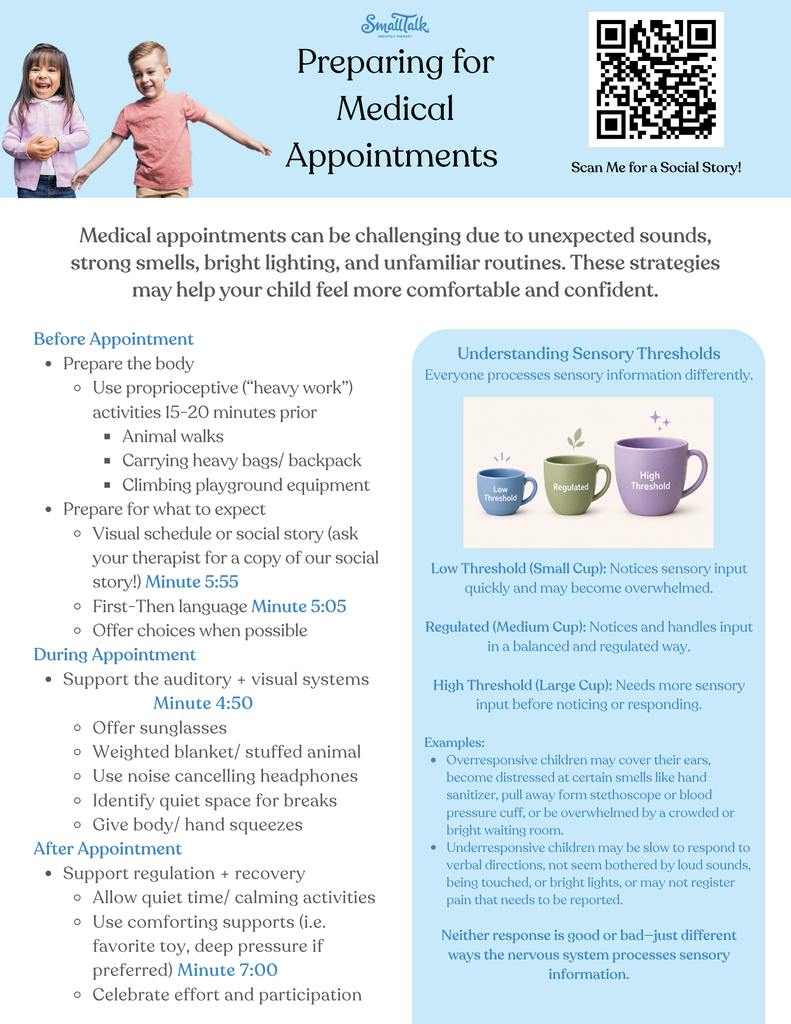
Medical appointments can be challenging for children who are sensitive to bright lights, unfamiliar smells, medical equipment, touch, or busy waiting rooms. Preparing your child for what to expect can help make the appointment more predictable. Before the visit, families can try heavy-work activities, use a visual schedule or social story, use first-then language, and offer choices when possible. During the appointment, children may benefit from headphones, sunglasses, a weighted blanket or stuffed animal, a quiet space for breaks, or hand and body squeezes.
After the appointment, allow time for calming activities and celebrate your child’s effort and participation.
Free Medical Appointment Resources
For Parents:
For Kids:

Preparing to Use a Public Restroom
Public restrooms can be challenging for children because of unexpected sounds, strong smells, bright lighting, unfamiliar routines, and sensory experiences associated with toilets, automatic flushers, faucets, hand dryers, and other bathroom features.
Before visiting a public restroom, parents can talk with their child about the sounds they may hear, use First-Then language, introduce a visual schedule or social story, and offer choices when possible. During the visit, noise-canceling headphones, ear defenders, covering the ears, standing farther away from hand dryers, or using paper towels may help some children.
Afterward, provide reassurance, positive feedback, and a calming activity if needed. Celebrate your child’s effort and success.
Free Public Restroom Resources
For Parents:

For Kids:

How to Use These Resources
Every child is different, so you may need to experiment with different strategies to find what works best for your child.
A few simple ways to use these resources include:
1. Read the parent handout first.
Learn about the sensory experiences your child may encounter and choose a few strategies that seem appropriate for your child.
2. Introduce the social story before the experience.
Give your child time to look through the story without pressure. You can read it together more than once as the appointment gets closer.
3. Practice when possible.
For some experiences, practicing at home can make the real experience feel more familiar. For example, the haircut resource recommends practicing pretend haircuts before the actual appointment.
4. Offer choices when you can.
Small choices can give children a greater sense of predictability and control. Depending on the situation, this might mean choosing which stall to use, whether to wear headphones, or which comfort item to bring.
5. Celebrate effort, not perfection.
Trying something new can be a big accomplishment. Recognize your child’s effort and participation, even when the experience doesn’t go exactly as planned.
Looking for More Support?
If your child regularly struggles with sensory processing, daily routines, or participating in everyday activities, occupational therapy may be able to help. SmallTalk Pediatric Therapy provides pediatric occupational therapy, speech therapy, social skills, and more services at our three clinics around San Diego county in La Mesa, Scripps Ranch, Mission Valley, and virtually. Reach out to our team to learn whether OT may be a good fit for your child.